The way of our Future.

Overview
As the cyber world drastically advanced over the last few decades and continues to evolve, online privacy, identities, and technologies have never been more under threat to harm, exploitation or cyber-attacks. With the world transitioning into the cyber realm and becoming more reliant on digital lifestyles, cyber security has increasingly become a concern.
Cyber Security branches to the collective technologies, processes, methods, and elements that combine to safeguard data, information, networks, and/or assets (hardware or software) of individuals, organisations, or businesses. The primary functionality and purpose revolve around the protection of confidentiality, identity, integrity, and security of people and groups from both internal and external harm or threats. This minimises the risk of unauthorised access to systems, violation of privacy, or the extortion of data, information, and assets.
Functionality
A highly efficient system of cyber security is designed to provide multiple layers of protection across networks, devices, and programs utilised by individuals, groups, or businesses. It works by eliminating or blocking incoming threats and breaches, whilst establishing a unified defense against potential cyber-attacks and hackers. Highly advanced security systems implement an effective combination of online defensive mechanisms to minimise the risk of incoming or potential cyber-attacks and breaches.
Such types and layers of protective mechanisms and techniques include application security, data or information security, operational security, cloud security, network security, and mobile security. The combination of these layers of protection allows cyber security systems to be able to effectively prevent any harm or threats, whilst detecting, investigating, and resolving potential weaknesses and vulnerabilities in the system before they can be exploited.
Implementation
There are three main protection levels through which cybersecurity can be implemented, each of which varies in intensity, function, and purpose.
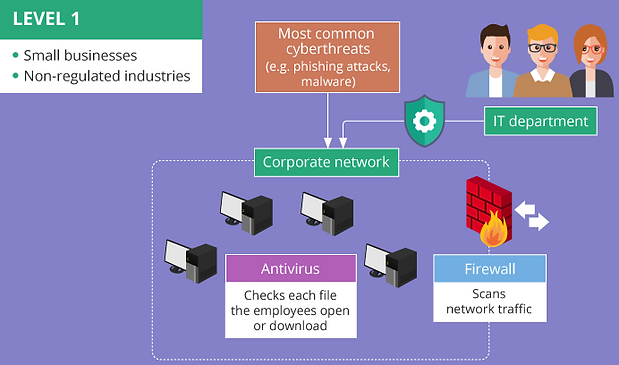
Level 1: Minimal
The key function of level 1 security is to ensure protection against common and less malicious cyber threats, which include phishing attacks, virus attached links or emails and malware (harmful viruses/softwares). It applies to devices of individuals or groups, as well as less widespread businesses operating in non-regulated industries with limited economic resources. Essential elements to such minimal cybersecurity level include a configured and functional firewall to filter the threats coming from incoming network traffic, and a regularly updated antivirus software to eliminate malware from causing harm.
Level 2: Advanced
The advanced security level preserves more corporate devices and networks from non-targeted threats, including malware sent to emails, spoofing attacks, and spamming. Most midsize businesses and enterprises implement such layer of digital safety, since the likelihood of them falling victim to non-targeted attacks, especially since they neglect strong defense measures in their networks. Some advanced protection techniques are email scanning for incoming internal or external harm/malware, segmentation of network via a firewall to block malicious code from intercepting data, and intrusion detection to identify and record any only security incidents. To maintain this system, usually, an external information security specialist team is hired (outsourcing) to manage and minimise cyber risks and attacks.
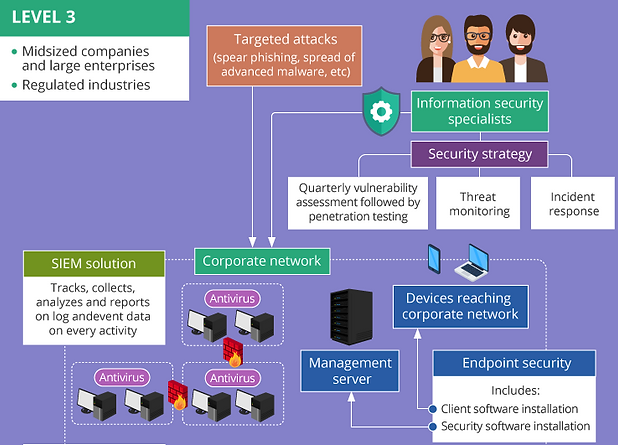
Level 3: Maximal
The primary purpose of maximal cyber security is to ensure a high standard of protection from targeted attacks such as spear phishing, advanced malware, ransomware, social engineering, and malicious code. Large enterprises and some midsized companies that operate in regulated industries like healthcare, government agencies, and banking employ this standard of online safety. To facilitate and operate maximal safekeeping, the combined efforts of an outsourced information security department and internal specialist are required, with consistent regulation to keep the security at a high level. Some implemented defensive mechanisms include: endpoint security which protects devices like desktops, mobile phones, and tablets from cyber-attacks through endpoint software, data loss prevention that prevents leakage of sensitive data/information, and security & event management, which analyse, report, and monitor the network environment for incoming or even potential threats.

Statistics

Security Tools